How to Run a Clean Boat Rental Turnaround: A Dock Crew Playbook
Boat rental revenue lives and dies on turnaround time. Here is how rental dock crews can keep pontoons moving, buffer time enforced, and the afternoon rush from turning into a scheduling mess.

Ask any boat rental operator what kills a holiday weekend, and the answer is almost never the bookings. It's the gap between the return and the next pickup — the 45 minutes that was supposed to be 20, the fuel that wasn't topped off, the damage note nobody wrote down before the next renter climbed aboard.
Turnaround time is where rental revenue either holds or leaks. A clean process protects your schedule, your margins, and your reputation. A sloppy one creates double-booking panic, unhappy renters, and a dock crew that spends half the day putting out fires instead of running boats.
This is a practical guide to running that turnaround well — what the process looks like, where it usually breaks, and how to close the gaps.
What a Rental Turnaround Actually Involves
A turnaround isn't just washing a boat. Between one renter pulling back in and the next one pushing off, your crew has to move through a predictable sequence:
- Confirm the returning renter is back on time (or handle a late return before it cascades)
- Inspect the hull, upholstery, engine, and accessories for any damage
- Log anything unusual before the returning party leaves the dock
- Refuel
- Rinse and wipe down
- Restock any gear (life vests counted, tubes reattached, coolers returned)
- Confirm the next renter's identity, payment status, and signed agreement
- Brief them on fuel policy, navigation limits, weather conditions, and return procedure
- Launch
That's nine steps. In a 20-minute buffer, you're doing math that leaves no room for surprises. In a 45-minute buffer, you've got some breathing room. That difference — the one between running a tight operation and running a stressed one — comes down to how your booking setup, your crew communication, and your day-of workflow are structured before anyone shows up at the dock.
Where Rental Turnarounds Usually Break Down
Most rental operators don't lose time in obvious ways. They lose it in a handful of small, recurring places that compound across a full day of boats:
Late returns without a heads-up
A renter runs 30 minutes past their return window. Nobody knows until the next renter is already at the counter. Now your buffer is gone, your crew is scrambling, and someone who booked a full day is watching their time shrink while the boat sits at the fuel pump.
The fix is a clear return-time policy in the booking confirmation and a final reminder sent automatically on the morning of the rental — not just a time, but what happens if they're late. Most renters who know there's a real consequence either return on time or call ahead. Both outcomes are better than silence.
No buffer time built into the calendar
When two consecutive bookings share the same theoretical return and departure time, you've already lost before the day starts. There's no calendar that runs without variance, and a rental calendar that doesn't account for turnaround isn't a schedule — it's a series of problems waiting to stack up.
Turnaround buffers belong in the booking system, not in your crew's mental calendar. Each boat's rental blocks should include mandatory gap time that prevents back-to-back pickups from ever appearing on the same hull. Set it once. Let the software enforce it on every booking automatically.
Damage disputes at the dock
A renter returns a boat. There's a scratch on the bow rail. Nobody photographed it before departure. Now you have a disagreement, an uncomfortable conversation, and no documentation to back either side up.
The standard is simple: a dock crew walkthrough with photos before every launch, logged against the reservation. Not stored in someone's phone — stored on the booking record where both you and your crew can access it if something comes up later. The rental agreement and damage waiver signed digitally before arrival establish the baseline; the pre-launch documentation closes the loop.
Crew who don't know what's coming
If your dock crew finds out about the 2pm return and 2:30pm pickup by looking at a whiteboard — or worse, by being told verbally while they're mid-cleanup on a different boat — your turnaround is already behind before it starts.
The today's screen exists for this. One view, every hull, every return time, every upcoming pickup, every add-on that was purchased. Crew see exactly what's out, what's due back, and what needs to be ready. They don't have to ask. They don't have to guess. They run the dock.
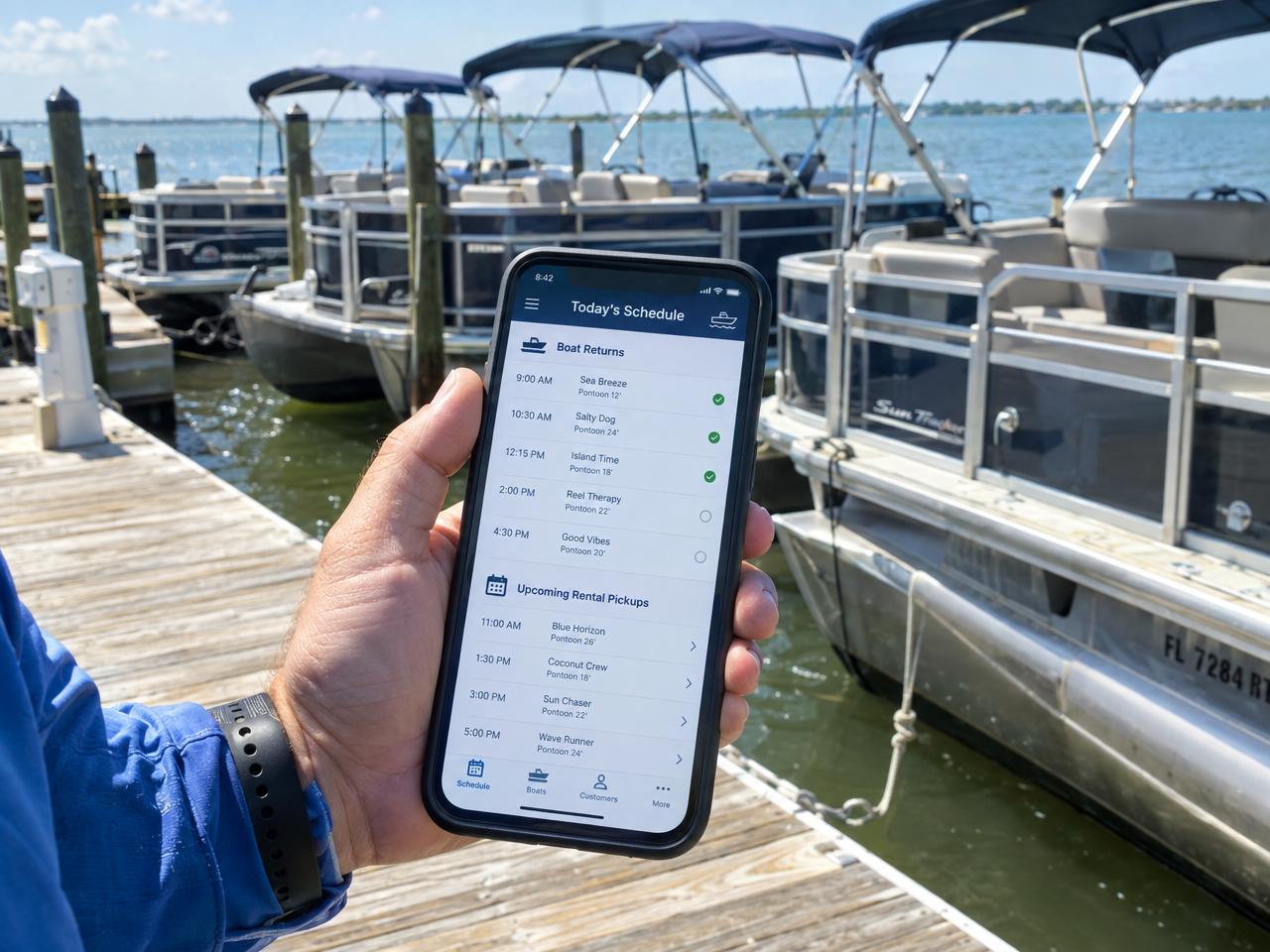
When crew can see what's due back and what's launching next from their phone, the turnaround runs itself.
Building a Repeatable Turnaround Process
The goal isn't a perfect turnaround on a quiet Tuesday. It's a consistent turnaround on a busy Saturday when three boats come back inside 40 minutes of each other and two walk-ups are standing at the counter.
Here's how to build a process that holds under pressure:
Anchor the buffer to the boat, not the booking
Every hull in your fleet should carry its own turnaround buffer — set at the boat level, not negotiated per booking. A pontoon that takes 30 minutes to fuel and prep gets a 30-minute buffer. A center console that turns in 15 gets 15. That configuration lives in your booking system and refuses to let any rental start earlier than the gap allows, no matter who's trying to book it.
Make the morning view your crew's single source of truth
Before the first renter shows up, your crew should be able to look at one screen and see the entire day: which boats are going out and when, which have fuel add-ons, which are returning before a tight next booking, and which have waivers still unsigned. If they need to call the office to get that information, you've added friction to every decision they'll make all day.
Treat renter history as a dock tool
Repeat renters aren't just good for revenue — they're operationally faster. A guest whose information, payment, and signed waiver are already on file doesn't stand at the counter for 15 minutes before launch. They show up, the crew confirms who they are, and they go. That time savings across a full fleet over a full season is real. Keep the records. Use them.
Log everything on the reservation, not in a notebook
Return notes, late fees, damage observations, fuel readings, accessory checks — all of it belongs attached to the booking, not in a spiral notebook behind the counter. When something comes up a week later, the record is there. When a renter disputes a charge, you have the documentation. When a new crew member covers a shift, they have the context.
What a Good Turnaround Day Actually Looks Like
Thursday night: two pontoons book for Saturday afternoon. Deposits clear automatically. Rental agreements and damage waivers get sent and signed on their phones before they leave home.
Saturday morning: your crew opens the today's screen. Both boats are flagged, return times visible, the fuel add-on one family purchased is listed on their record. The 11am return and 12pm next pickup has a 45-minute buffer. Manageable.
11:10am: the first renter calls in — they're running about 20 minutes behind. Crew adjusts. The 12pm next renter gets a heads-up that departure is pushed to 12:30. No panic, no scramble. Just a quick update that keeps both parties informed and your schedule honest.
12:35pm: the boat is fueled, wiped down, and the crew has the next group at the counter. Waiver is already signed. Briefing takes five minutes. They launch at 12:42.
That's a good turnaround day. Not because nothing went sideways — one did — but because the system absorbed the variance without it cascading into the rest of the schedule.
The Systemic Side of Smooth Turnarounds
None of this is about finding better crew or working faster. The operators who run the cleanest turnarounds aren't better at scrambling. They've removed the need to scramble by building the right structure before the season starts.
That structure includes:
- Buffers baked into each boat's booking calendar at the fleet level
- Rental agreements and waivers signed digitally before arrival — not on a clipboard at the counter
- A today's screen visible to dock crew on their phones, not on a whiteboard in the office
- A renter record that persists across visits so repeat guests move faster
- Return and reminder communications that go out automatically — not from someone's personal phone
When those five things are in place, turnaround day isn't stressful. It's just the job.
One Question Worth Asking Right Now
Look at last Saturday's schedule. Find your tightest turnaround. How long was the buffer between that return and the next pickup? Was it enforced by your booking system, or was it a number someone hoped would be enough?
If the answer is the second one, that's the gap worth closing before the next busy weekend. The buffer doesn't protect your crew's stress levels. It protects your revenue, your renter experience, and your season.
VrixPlay builds turnaround buffers directly into each boat's calendar, gives your dock crew a real-time today's view on their phones, and keeps rental agreements, waivers, and renter history on every reservation. If you're running a rental fleet and still managing turnarounds off a whiteboard, take a look at how VrixPlay handles it — setup is same-day, and the team in Destin does the migration for you.