How Tour Boat Operators Can Run Cleaner Departures with Per-Seat Ticketing
How tour boat and cruise operators use per-seat ticketing to fill departures, track guests, and run smoother check-ins — without paper manifests or last-minute scrambles.

Running a private charter and running a tour boat look like the same business from the outside. Both involve water, guests, and a departure time. But the day-to-day operation is completely different — and the booking tools that work well for a private fishing charter can quietly create real problems for a tour boat running four shared departures a day.
The core difference is this: on a private charter, you book one group at a time and build the whole trip around them. On a tour boat, you sell individual seats on a fixed departure to anyone who wants to come. Families book two seats, couples book two more, a solo traveler grabs one. By the time the boat is ready to leave, you might have a mix of twelve strangers who all booked on different days, through different channels, at different prices.
That is where things get complicated if you do not have a ticketing system built for it.
What Per-Seat Ticketing Actually Means
Per-seat ticketing is exactly what it sounds like: guests pay for a specific number of seats on a specific departure, not for the whole vessel. The departure is scheduled in advance by the operator. Guests browse open departures, choose how many seats they want, and check out online. Each booking creates a separate guest record with its own payment status, waiver status, and confirmation.
The operator does not book individuals one by one. They set the departure — date, time, total capacity, price per seat — and let guests fill it. When a seat is purchased, it comes off the available count automatically. When the departure is full, it closes.
For dolphin cruises, sunset tours, snorkel trips, and similar operations, this is the natural model. It is how guests expect to book, and it is how operators can actually manage a vessel that runs multiple trips in a single day.
The Manifest Problem on Paper
Without a structured ticketing system, tour boat operators usually end up managing their passenger list in a spreadsheet or a reservation notebook. Someone takes a call, adds a name and a headcount, and writes down a card number to charge later. Someone else books through the website form and sends an email. A walk-up shows up at the dock and gets added to the list by hand.
By departure time, the manifest is a mess. Names are spelled differently on different records. It is not clear who paid a deposit, who paid in full, and who still owes. No one has signed a waiver because there was no clean way to send one in advance. The crew is standing at the gangway trying to reconcile a printed sheet with the actual humans showing up.
This is not a rare edge case — it is what happens when a per-seat operation tries to run without per-seat tools. The result is delayed departures, confused guests, and a crew that spends the first fifteen minutes of every trip doing administrative work instead of getting people excited about what they are about to see.
How the Booking Flow Works from the Guest Side
When per-seat ticketing is set up properly, the guest experience is clean and familiar. They land on your booking page, see the available departures, select a date and time, choose their seat count, add any extras you offer, and pay. That is it. Within a minute of completing checkout, they get a confirmation email with a QR code tied to their booking.
They do not need to call you to confirm. They do not need to remember a booking number. They just need to show up with that QR code — which lives in their email and works from any phone.
If you require waivers, they can complete those before they ever leave the house. The waiver link goes out automatically with the confirmation, and their signed status shows up in your dashboard so crew can see before the boat leaves who is still missing a signature.
What the Operator Sees on Their End
On the operator side, per-seat ticketing means every departure has a live manifest that updates in real time as guests book. You can see total seats, seats sold, seats remaining, and individual guest records for everyone on that trip. Each guest record shows their name, seat count, payment status, waiver status, and any special notes from the booking.
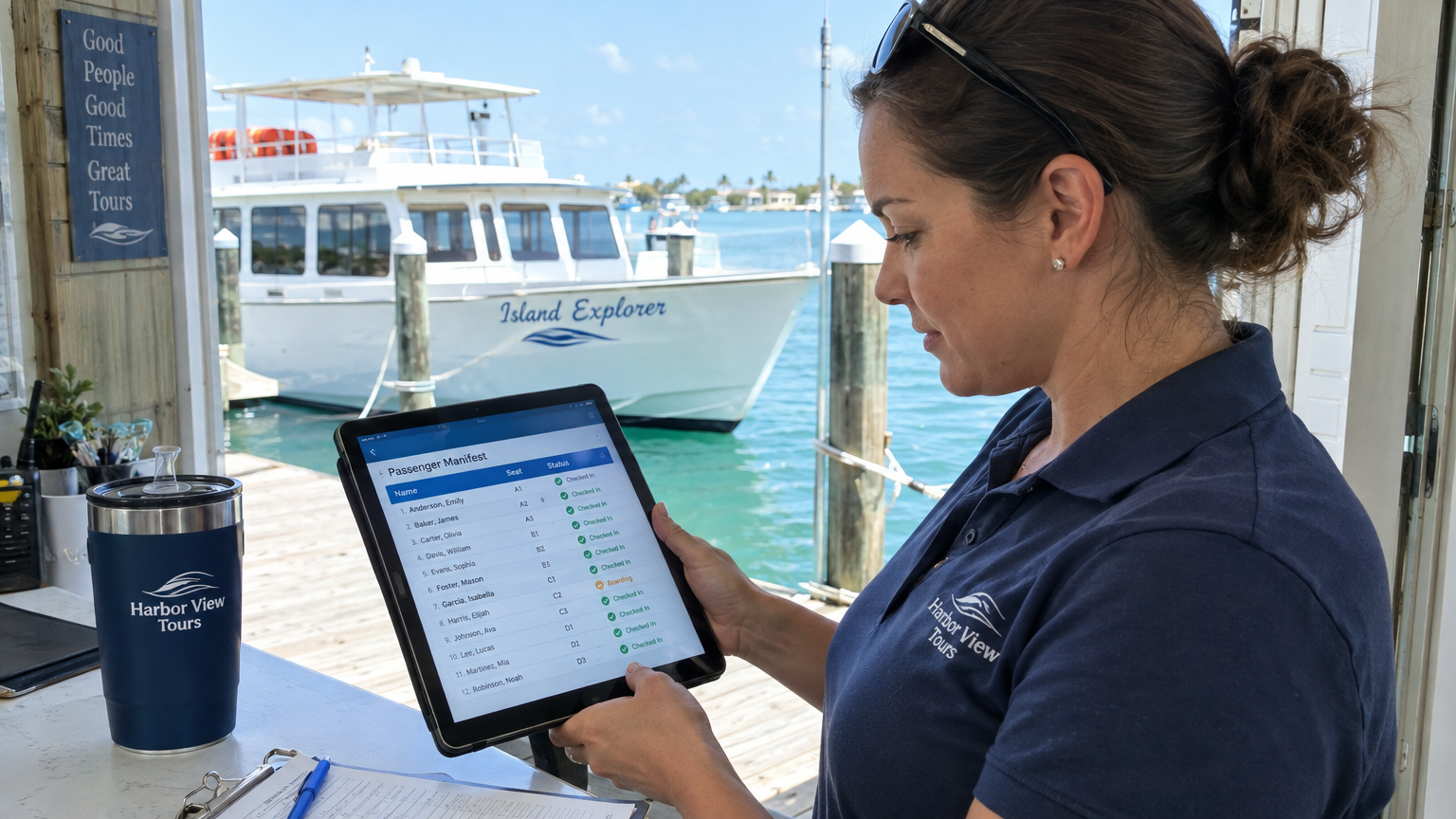
A real-time manifest takes the guesswork out of every departure.
Before you leave the dock, you can see at a glance:
- Which guests are fully paid
- Which guests have outstanding balances
- Which guests have completed their waiver
- How many total passengers are on board
You can pull that manifest up on a phone or a tablet. There is no printing required, though you can print a Coast Guard-ready passenger log if your operation needs one.
For operators running multiple departures in a day — a morning trip, a midday trip, and a sunset cruise — this structure means each departure is managed independently. A guest who books the 4 p.m. sunset cruise does not mix into the 10 a.m. dolphin tour manifest. Everything stays organized by trip without any manual sorting.
QR Check-In at the Dock
The check-in step is where per-seat ticketing pays off most visibly. Instead of reading off names from a list and crossing them out by hand, crew can scan the QR code from each guest's confirmation email directly from their phone camera. The system confirms the guest is on the manifest, marks them as checked in, and flags any duplicate scans so no one boards twice.
For a departure with a mix of families, couples, and solo travelers, this brings boarding from a five-to-ten minute scramble down to about a minute per group. Guests feel taken care of. Crew can focus on safety prep and guest experience instead of paperwork. The boat leaves on time.
Walk-ups can still be added manually if you have capacity. Add them to the manifest on the spot, take payment, and send them a QR code or check them in directly from the dashboard. The system treats walk-ups the same as online bookings so the manifest stays accurate regardless of how someone got on board.
Capacity Management and Blocking
One of the less obvious benefits of per-seat ticketing is that it handles capacity automatically. You set the total seat count for a departure, and the system closes online bookings when that count is reached. You do not have to monitor it or manually close a link. The booking page updates in real time.
You can also block departures for maintenance, weather holds, private buyouts, or any other reason. Blocked departures stay off the public booking page without deleting the departure record. If conditions change and you want to reopen the slots, you can do that too.
For operators who also sell on third-party marketplaces, managing seat inventory across channels requires careful tracking. A clean internal system gives you a clear count of what you have available before you decide how many seats to make available elsewhere.
Building the Guest Relationship After the Trip
Tour boat guests who had a great time are natural candidates for repeat visits and referrals. A post-trip workflow — thank-you email, tip link, review request — helps you capture that momentum before it fades. When every guest record is stored cleanly in your system with their contact information attached to a specific trip, sending that follow-up is straightforward. You know exactly who was on the 4 p.m. sunset tour last Tuesday and you can reach them by name.
That guest data also builds over time. Repeat visitors accumulate booking history. You can see who has come back multiple times and treat them accordingly.
The Right Tools for a Per-Seat Operation
VrixPlay is built to handle per-seat departures for tour boats, dolphin cruises, snorkel trips, and similar shared-vessel operations. You schedule a departure, set your capacity and price, and guests fill seats through your public booking page. The manifest, payment tracking, waiver status, and QR check-in are all connected in one dashboard that works from your phone at the dock.
The platform is free to use, with a flat 3 percent per booking and no monthly subscription. If your operation is currently managing guest lists in a spreadsheet or juggling email confirmations by hand, moving to a per-seat ticketing setup is one of the higher-impact changes you can make going into next season.
If you sell time on the water by the seat, start free at VrixPlay — no card required and setup takes about 15 minutes.