How Tour Boat Operators Can Stop Overselling Departures
Selling tickets across multiple channels without real-time capacity control is how tour boats oversell. Here is how to fix it before peak season.

It usually starts with a holiday weekend. You sell tickets on your website, take a few phone calls at the dock, and your OTA listing keeps running in the background. By Friday afternoon you have 46 people confirmed for a 40-seat sunset cruise. Someone has to make uncomfortable calls. Some guests get bumped to a later departure that is already close to full. The first impression of your operation is an apology.
Overselling is not a demand problem. Operators who oversell consistently have plenty of guests who want to come out. The problem is a systems problem: when tickets flow from multiple places and no single source enforces real capacity, the math always catches up at the worst moment, when guests are standing at the gangway with expectations and nowhere to put them.
Why Overselling Happens on Tour Boats Specifically
Charter fishing boats run one private group at a time, so the head count locks the moment a booking is confirmed. Tour boats work differently. You sell individual seats to strangers who may book separately, ask questions later, and add guests the morning of departure. When capacity is tracked in four different places at once, none of them can be trusted.
Here is the scenario most tour operators recognize:
- Your website sells 12 seats for the 5:00 p.m. departure.
- Someone calls and you hold three more while they confirm with their group.
- Your third-party listing sells six more in the meantime.
- A walk-up family of four arrives at the dock assuming they can get on.
The boat holds 40 people. You are at 25 on paper but have no real count because the phone seats were never logged, the OTA numbers lag, and the walk-ups were not accounted for anywhere. By boarding time you are guessing. Sometimes the guess is off by a few seats. Sometimes it is off by more.
The Real Cost Beyond the Angry Guest
The obvious cost is the conversation at the dock: the apology, the partial refund, the guest who posts a one-star review before you have even left the slip. That part is painful but visible. The costs that are harder to see add up faster.
When guests get bumped, the story they tell is not about bad luck. It is about a disorganized operation. That story spreads in group chats and travel forums where your next group of customers is already making decisions. A single oversell incident on a holiday weekend can shadow your review average for a full season.
There is also the operational chaos it creates. Boarding slows because the count is wrong. Your crew is trying to sort out who has a ticket and who is a walk-up while the departure time slides. The guests who did get on board feel the tension and start their experience already a little uneasy.
What Real Capacity Control Actually Looks Like
Solving the oversell problem means enforcing one number across every channel where tickets sell. That is not a process change. It is a systems change. When a seat sells anywhere, online, by phone, or through an OTA feed, it has to come off the available count instantly and everywhere else.
For tour and cruise operators, a few things have to be true simultaneously:
One departure calendar, one seat count per slot. Every departure has a defined capacity. When that number hits zero, the booking closes automatically. Walk-ups can still happen, but they are added manually against a live count the dock staff can actually read. No more mental math, no more rough estimates on remaining seats.
Recurring departures that build themselves. If you run three sunset sails every Friday and Saturday from May through September, you should not have to create each departure individually. A well-built system publishes your recurring schedule once and keeps selling into it without you touching the calendar every week. When you need to block a date for weather, maintenance, or a private charter, that override applies instantly across all booking channels.
Phone and walk-up bookings logged immediately. The gap in most operations is the phone call that never makes it into the system. Someone calls, you hold two seats, they call back two hours later to confirm, and by that point you have already sold those seats online. Phone and walk-up reservations need to go straight into the same booking record as online tickets in real time, so the count is always accurate.
Manifests that close before departure. A passenger list is not just paperwork. When it populates automatically from your bookings, your crew can see headcount, waiver status, and ticket type per guest before the gangway opens. If the list says 38 and 42 people are in line, you know immediately, not after everyone is on board and the captain starts counting heads.
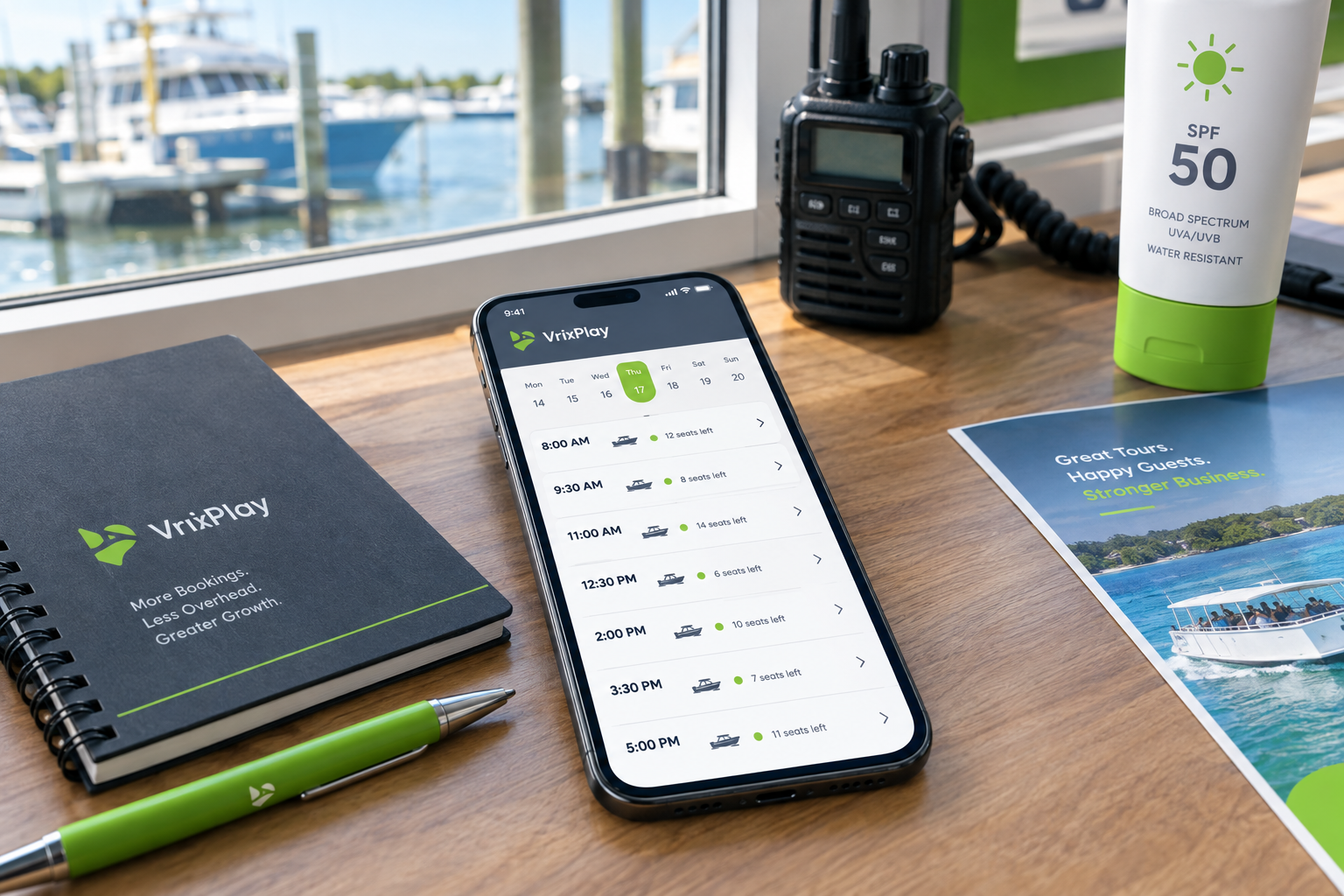
Seeing remaining seat counts per departure in real time is what prevents overselling before it reaches the dock.
Group Bookings Are Where Capacity Gets Complicated
Individual ticket buyers are easy to manage once the system is set up correctly. Groups are where most tour operators lose count without realizing it.
A school group of 30 books your 10:00 a.m. snorkel trip three weeks out. You confirm the booking and hold the seats. In the meantime, 12 individual tickets sell for the same departure because the group reservation was not yet reflected in available inventory. By departure morning you have 42 people for a 40-seat boat.
Group bookings need to lock capacity at the moment of confirmation, not at the moment of final payment. If your system does not reduce available seats the second a group hold is placed, you will oversell every time you take a large reservation alongside active online sales.
At the same time, groups and individual guests need to move through the same boarding flow. QR codes on mobile, scanned at the gangway, work for a family of three and for a 25-person corporate outing equally well. The crew does not need a different process for each ticket type. They scan, the name appears, the guest is marked aboard, and the manifest updates.
Weather and Cancellations: The Other Half of the Problem
Capacity management goes both directions. When you have to cancel a departure because of a storm rolling in, a mechanical issue, or bad tide conditions, you need to notify every ticket holder on that specific departure at once and give them a clear path to rebook or refund without handling each transaction individually.
Operations that run cancellations by phone call and individual email threads lose hours of time and often leave a few guests who never got the message standing at the dock in the rain. A system that ties contact information to each booking seat can reach all 36 ticket holders simultaneously with a single action. Guests get a notification on their phones, they know what their options are, and your team handles logistics instead of a call list.
What Changes When Capacity Is Under Control
The boarding experience is the clearest improvement. When every seat on the manifest is confirmed and waivers are already signed, boarding becomes a scan and a smile. Guests who pre-booked feel like they are in the right place. Walk-ups, if you take them, are slotted into genuinely open seats. The crew starts the trip with an accurate headcount and no unresolved questions.
Revenue visibility also improves. When all ticket sales flow through one system, load factor per departure becomes a real number you can act on. You learn which time slots consistently sell out early and which ones underperform. That data tells you whether to add a departure, adjust pricing, or cut a slot that reliably leaves seats empty.
And the guest experience extends beyond boarding. Automatic confirmation messages, arrival instructions, and reminders with waiver links go out without anyone on your team composing them. By the time guests arrive at the dock, they know where to park, what to bring, and what to expect. The first real interaction is a QR scan at the gangway, not a scramble to figure out who is on the list.
Getting There Without Rebuilding Everything at Once
Most tour operators do not need a lengthy software migration to fix the oversell problem. They need a single platform that handles their departures the way the operation actually runs: by the seat, with real capacity, across however many channels they sell through.
The practical starting point is consolidating ticket sales behind one booking calendar and cutting off any channel that does not connect to it in real time. That alone eliminates the core source of the oversell. Phone bookings log into the same system. Walk-up capacity is visible at a glance. The manifest closes before the ropes come off.
VrixPlay is built for exactly this kind of operation. Per-seat ticketing with live capacity, recurring departures, automatic reminders, QR boarding passes, and passenger manifest management all run on a free platform with a flat 3% per booking. If you run dolphin cruises, sunset sails, snorkel trips, or sightseeing tours and you are still reconciling seats across multiple channels, it is worth seeing how the whole operation runs in one place.