How to Run Recurring Tour Boat Departures Without Overselling a Single Seat
Tour boat operators: learn how to publish recurring departure schedules, enforce real seat capacity, and board full boats faster — no spreadsheet math required.
If you run dolphin cruises, sunset sails, snorkel trips, or any tour that departs on a schedule, you have probably done the math in your head at the worst possible moment. Someone calls for four seats on Saturday's 5:30 departure while you are answering a DM about the same trip, and two seats already sold on your website overnight. By the time you sort it out, you have eleven people confirmed for a boat that holds ten.
Overselling is not really a booking problem. It is a system problem. Specifically, it is what happens when seat inventory lives in more than one place at once.
Build the Schedule Once, Let It Sell Itself
The standard workaround for a busy tour operation is a shared spreadsheet, a wall calendar, or a reservation notebook passed between staff. It works until it doesn't, and it usually stops working during your busiest weekend of the year.
The more practical approach is to build your departure schedule once and let the system handle everything downstream. Set up your Monday-through-Sunday recurring schedule — 10:00 AM snorkel trip, 1:00 PM dolphin cruise, 5:30 PM sunset sail — and those departures publish automatically on a rolling basis. You are not re-entering the same times every week. They are just there, taking bookings, enforcing capacity, sending confirmations, while you are on the water doing the actual job.
When you need to override a single date for weather, a private hire, or a holiday closure, you override that date only. The rest of the schedule keeps running.
Real Capacity, Not an Honor System
Online ticketing is only as reliable as the number enforcing the limit. If your booking page shows 40 seats available but does not lock that number at the moment of purchase, you are trusting guests and your own staff not to exceed it simultaneously.
The right setup gives every departure a hard seat count. When the last seat sells, the departure closes. Walk-ups and phone calls go into a manual entry that draws from the same inventory, so the number is always accurate regardless of how the booking came in. Adult, child, and senior pricing can each have their own rate against the same shared capacity pool, so a family of three buying a mix of ticket types does not accidentally consume more slots than you intended.
The result is a booking page guests can actually trust. When they see six seats remaining on Thursday's 5:30 departure, that number is real. That reliability turns browsers into buyers faster than any promotional copy you could write.

A manifest that builds itself lets you focus on the departure, not the paperwork.
Boarding a Full Boat in Minutes
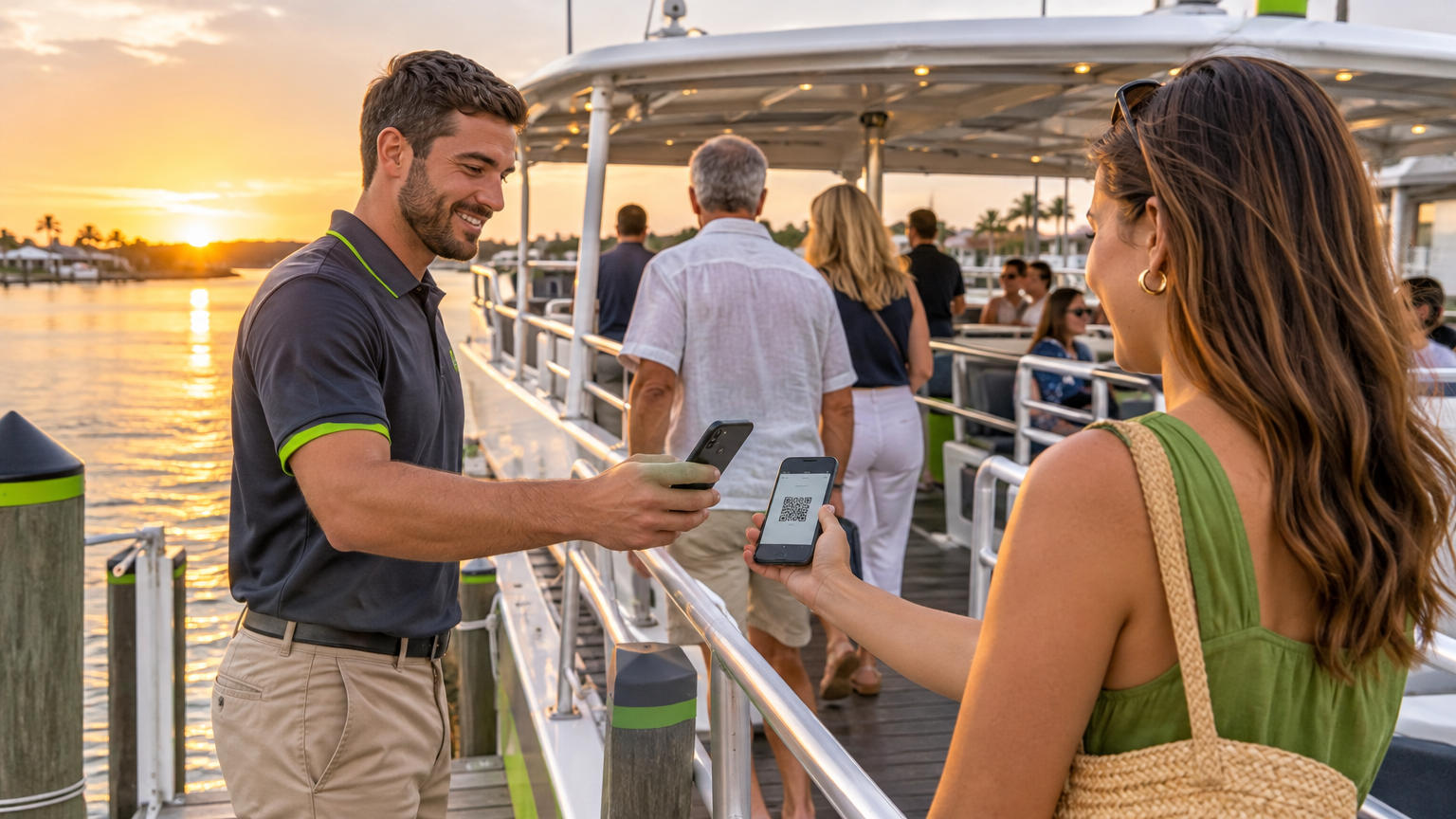
Every guest who books online gets a QR code in their confirmation email. At the gangway, you scan it from your phone camera — no extra hardware, no printouts, no cross-referencing a name against a handwritten list. The manifest marks them checked in. Duplicate scans flag immediately so a guest cannot board twice or share a code with someone who did not book.
For a boat carrying 40 people, the difference between scanning QR codes and manually verifying names is about 15 minutes of boarding time. On a sunset cruise that departs at 5:30 and returns at 7:30, those 15 minutes matter. You leave on schedule, the experience starts on time, and nobody is standing at the gangway frustrated before they have even stepped aboard.
The Manifest Builds Itself
Every departure carries a live passenger list: headcount, guest names, waiver status. If you require guests to sign a liability waiver, those signatures collect digitally before they arrive. The manifest shows you at a glance who has signed and who still needs to, so the waiver conversation at boarding is a quick check rather than a clipboard shuffle.
Group bookings fold in cleanly. A family of five and a 40-person school group go through the same booking flow and show up on the same manifest. No separate spreadsheet for the group, no manual counting to reconcile against individual reservations.
Weather Cancellations Without the Phone Tree
Weather is the one thing every tour operator plans around and cannot fully control. When you cancel a departure — a squall line rolling in, seas that are rougher than guests signed up for — the notification problem starts immediately. Who has the list? Who is calling whom? Did someone already text the wrong departure time?
A cleaner workflow: cancel the departure from your dashboard, and every ticket holder on that departure gets notified at once. From the same screen, you can offer a rebook to another open departure or process refunds. No phone tree, no one falling through the cracks because their confirmation email was in a different inbox folder.
Know Which Time Slots Actually Earn
Load factor is one of the most useful numbers a tour operator can track, and most operators do not track it at all because pulling it requires manual counting. When every departure runs through one system, that number is just there: revenue per departure, seats sold versus capacity, which time slots consistently sell out and which ones consistently underperform.
That information is worth real money. If your 10:00 AM snorkel trip runs at 60% capacity three Sundays in a row while the 1:00 PM departure sells out, you have a scheduling question worth asking. If Tuesday departures consistently underperform, that is an argument for pulling that slot and redirecting the crew hours.
You cannot make those calls without reliable numbers, and reliable numbers require a system that actually records every booking against the right departure.
What This Looks Like in Practice
Picture a week running on a connected departure schedule. Monday, the weekly schedule publishes without you touching anything. Wednesday night, 22 tickets sell across two upcoming departures while the boat is docked and the crew is home. Thursday afternoon, every guest on the 5:30 departure gets an automatic reminder with arrival time, parking directions, and what to bring. At 5:45, boarding is a scan down the gangway and you depart on schedule with a full manifest closed.
That is the operational version of scaling without adding overhead. The boat gets fuller. The admin stays flat.
Getting Set Up
VrixPlay's tour and cruise dashboard is built specifically for this workflow: recurring departures, real-time seat capacity, QR boarding, automatic guest communications, weather cancellation tools, and load factor reporting. It runs on the same free-software, 3%-per-booking model as every other VrixPlay vertical, with no monthly subscription and setup that takes about 15 minutes to get a live booking page.
If your current system is a spreadsheet, a wall calendar, or a reservation notebook passed between staff, the gap between where you are and where this workflow puts you is smaller than it probably feels. The schedule builds once. The system handles the rest.